


Two weeks ago, I stepped back onstage for the first time since my Olympic lifting days. No, I wasn’t slinging heavy bars from the floor to overhead at lightning speed. I was doing something much scarier.
Singing.
Dancing.
Emoting.
In front of an audience.
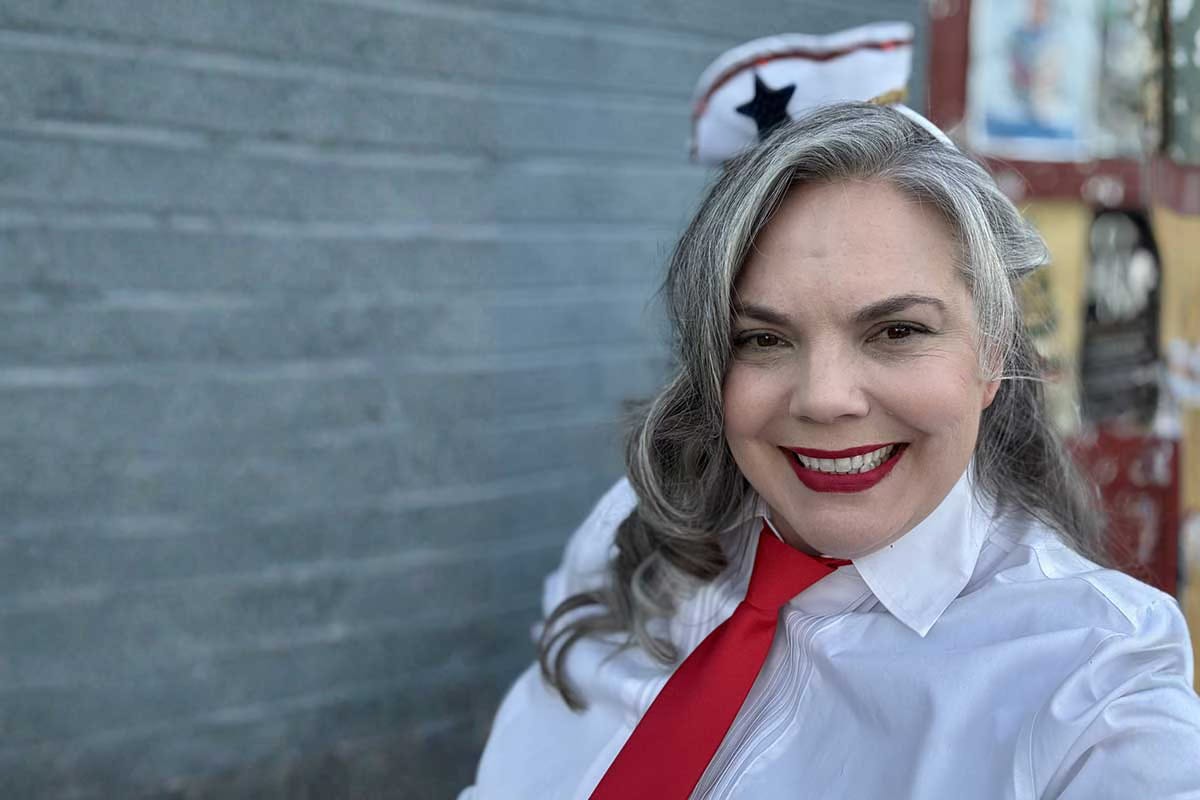
Those of you who know me well (which is not most of you but a few of you) know this is way, way outside of my comfort zone.
Whatever compelled me to do this?
At the end of October, I attended a women’s writing retreat in Maine. Magical is the only word for it. I met the most amazing women. Bold, passionate women making meaning of their lives through writing.
Somehow, we all left our facades at the door. The bonds were fast and strong.
In a small-world twist, it turns out two of the dozen-ish women live near me in Austin. One of them is a playwright.
On our final day at the retreat, just three of us gathered around the long conference table in the inn that had served as our primary gathering space, one of the women suggested I find a creative outlet that had absolutely nothing to do with my writing. Something to get me out of my head.
“You could be in my play,” the playwright offered. I couldn’t tell if she was serious.
Either way, I was in, knowing nothing more about it than it was political satire and would be performed during a longstanding Austin festival around Valentine’s.
Now, I am a creature of habit. The last time I asked my husband to charge my phone before bed, he knew my OS would get upgraded overnight, and he knew, he knew, I’d have a fit about the changes (he had already upgraded). Predictably, when I woke up to a new OS, I was a simmering pot of rage. (How dare he, I fumed silently, unwilling to give him the satisfaction of ranting about the thing he knew I was ranting about.)
But I also love pushing beyond my comfort zone, especially with things that feel like growth opportunities. I also don’t commit lightly. When I give my word, it’s solid. So when my now-friend suggested the play, I fully committed.
It was later, much later.
After our first cast meeting and read-through.
After I had already suggested the parts I wanted to play.
Even after our first few rehearsals.
Only then did I start piecing together what would actually be required of me on that stage.
My little autistic brain, the nickname for my late-adult diagnosis, had been thinking so literally, like it likes to do. I’m just reciting lines, it had assured me.
Turns out, it’s a little more than that.
It’s also emoting. And not just when I’m speaking but the entire time I’m onstage. Gulp. I had not actually considered this.
Also, no one told me this was a musical, that I’d be singing and dancing and learning choreography and having to be coordinated in time with other people. There is a reason I do things like lift weights and ride bikes for fun.
The whole first month of rehearsals was spent on choreography, mostly the opening number, which required me to move in sync with two experienced theater women. We were playing USA Girls, a flirtatious, ‘50s-era trio who smile and look pretty while blindly following a racist, sexist leader who might or might not resemble our current one.
The hardest part wasn’t moving my arms and legs in time with other people. It wasn’t even the singing, although I was the only one without formal training and the only one who hadn’t acted since elementary school.
No, no. The real problem was my face.
I was going to have to convey emotion. Smiling, specifically.
I knew I was in trouble. Because if there was one message I’d absorbed from my 40s, it was: you’re hard to read. I’m hard to read because I have trouble verbalizing and displaying emotion.
Low affect. That’s how one boss phrased it.
Spock. That’s what the leadership trainer called me when he saw I was a 10 out of 10 on the logic scale. In a room full of my peers, he went around the conference table and asked: “How many of you have trouble reading her?” All hands shot up.
“Do you want to know what she’s thinking?” he asked, and again all hands went up. “It’s really very simple,” he said, pausing for dramatic effect. “All you have to do is ask her.”
Duh. So simple. Why had I never thought of this? I’m such a straight-shooter. If you really want to know what’s going on inside my head, just ask.
Except that wasn’t going to work in this instance.
I was going to have to emote. And not just emote. But smile. And react. And actually look like I was react to what was happening on stage, rather than simply regurgitating words. This is how naive I was. I hadn’t even considered I would still need to be “in character” when I wasn’t speaking.
My mind immediately went back to all the interviews I had watched with famous actors who talked about losing themselves in a character. Or becoming the character. There’s no way this was going to be my Jeremy Strong moment. Something else would need to be done. Maybe I could pretend to be someone else and act out their thoughts and feelings? Even that would be a stretch.
Since my diagnosis, I’ve gotten better at performing in spaces that don’t quite make sense to me. Good enough that most people don’t notice the effort. When I tell them I’m autistic, they feign surprise and tell me no, as if I’ve confessed to something tragic.
But on stage, it’s different. Everyone knows it’s performance. The rules are clear.
We’re all playing parts. Just trying to make it look real.
About a month into rehearsals, still two months from show time, I decided I needed to learn how to smile for this character. My husband helpfully suggested I study cheerleaders (who knows how he came up with this, but it was smart thinking). I watched a few videos and realized that a cheerleader smile wasn’t quite right for this performance, so I moved onto pageant videos and found this how-to. Then I went to the mirror to practice.
At first, I couldn’t seem to make the curves of my mouth turn up on command.
This is so weird, I told myself, I know how to smile.
I do completely let my guard down and smile sometimes, I assured myself.
Mostly with my husband. But somehow in this new and strange environment, the idea of needing to put a smile on my face and hold it for an extended period of time, in front of strangers, was like throwing myself into the deep end of the swimming pool for the first time. I tried curling my mouth up with my mind. It refused to play along.
I remembered hearing that if you couldn’t read someone’s expressions, you should try mirroring them to figure out the emotion. So I put both of my index fingers into the corners of my mouth and pushed my smile into a U-shape and then attempted to hold that position all the way to rehearsal.
I figured I would learn one smile and then plaster that on for the entirety of my performance, but, no, I quickly learned from the YouTube video that is a one-way ticket to creepy town. You have to vary your smile. And don’t just paste it on when you walk onto the stage. No, no, you need to start it before you get out there.
Here are a few more tips I learned from the pageant lady:
Relax your jaw. Smile, but not too wide. You don’t want your mouth to be so big that people can see down your throat. Your teeth should be slightly or almost touching. And don’t push your tongue through your teeth (as if this is possible). You also don’t want to smile so hard your eyes close. Somehow you’re supposed to find the perfect balance between smiling naturally without shutting your eyes.
“Enlarge your eyes just a little bit, but not to the point where you look like a deer in headlights,” the pageant lady exclaimed brightly.
She had one bit of advice that cracked me up: don’t cheese so hard. What? I had never heard anyone use the phrase cheesing. Wouldn’t cheesing be a good thing?
She went on to sum it all up by saying you want a natural smile, a natural eye, and a natural face, all working together. It seemed impossible, but I had to try.
It was all so overwhelming at first. I felt so incredibly awkward (okay, it’s still awkward), but I mirrored one of my fellow USA girls, who is so good at turning it on. Eventually, I got used to cheesing in front of my fellow castmates in rehearsal, mostly because they were all doing it and making it look so easy.
Somehow, somehow, I learned to smile, say my lines, move my body, hit my steps, change my costume, and do all the things onstage without screwing it up. It was time to do it in front of an audience, a proposition that filled me with mild fear. A low-grade hum of anxiety permeated the days leading up to our performance. I wondered how it would compare to the full-on somersaults I used to get in the pit of my stomach ahead of big weightlifting meets, but they never came.
Part of me knew from years of competing that “performance adrenaline” could be too much of a good thing and was best tempered, so I did what I could to keep it from rising up inside me, repeating my lines and deliberately not peeking behind the curtain separating the performers from the crowd as we waited the excruciating hour backstage for the show to begin.
My fellow performers made it easy.
We huddled in a circle outside the theater ahead of our first performance, running through the songs like we’d been doing them forever. The words, which at first were foreign, now came as naturally as breathing.
I sang from the heart, smiling without feeling self-conscious.
It felt good to be part of something.
Now that I’ve put it all out there …
I’d love to hear what this piece stirs up in you.


Stepping out of your comfort zone feels like stepping off a cliff, but it's amazing how often we're able to grow our wings on the way down. Congrats on your stage debut!
It's a fantastic performance - congrats to you all for getting selected for the festival!