


I’m using the word fat throughout this piece as a neutral body descriptor.
This summer, in the middle of hanging off a cliff face high above the inky waters of a Quebec fjord, I decided I was done trying to prove my body could do hard things.
My husband and I were in the final stretch of our three-week escape from Texas. We had spent days hiking gorgeous gorges throughout the Finger Lakes region of New York and would soon be zipping across the St. Lawrence in a tiny Zodiac in search of whales.
But at that moment we were in the Parc national du Fjord-du-Saguenay, tackling something called via ferrata.
We had come for the whales, but my husband thought we should tack on a few days so we could explore the surrounding wilderness. I envisioned hiking, but quickly learned kayaking was the quintessential way to take in these towering, glacier-carved cliffs. I wasn’t sure he’d go for it with his bad back, so I started looking for alternatives. That’s when the words via ferrata hit the screen.
To be clear, I had no idea what a via ferrata was.
From the brief description online, I assumed it was a four-hour intermediate hike with a few sketchy, exposed sections where you’d need to be clipped in before going back to hiking. But it was billed as one of the most unique experiences in Eastern Canada, and that’s all it took. (My husband and I need almost no persuasion to try something novel.)
I did no further research into this via ferrata, nor did I read the helpful checklist included with my booking confirmation, which forced us into a last-minute stop in Montreal for technical pants and fingerless gloves. Even then, we weren’t prepared. I ended up begging/borrowing a pack from a kind ranger after our guide told us we’d need at least two liters of water between us or we wouldn’t be allowed to go. To say we were underprepared was an understatement.
Still, I wasn’t worried about whether I could physically do it.
I should back up and say, I’ve spent the past few years easing into my new, heavier body by putting it through various athletic and adventure tests, most often on vacation. I wanted to know whether I could still do all the things I used to do before I quit diets. A crazy jungle hike and rushing-water swim to a hidden waterfall in a slot canyon in Costa Rica. A steep cliff-side descent to a hidden black-sand beach in Maui. Waterfall rappelling. Mountain biking and hiking on pretty much every trip.
For this activity, the only thing I checked before I booked it was whether there was a weight limit—the one thing that might actually keep me from doing it. I was well under, so I didn’t give the physical demands much thought.
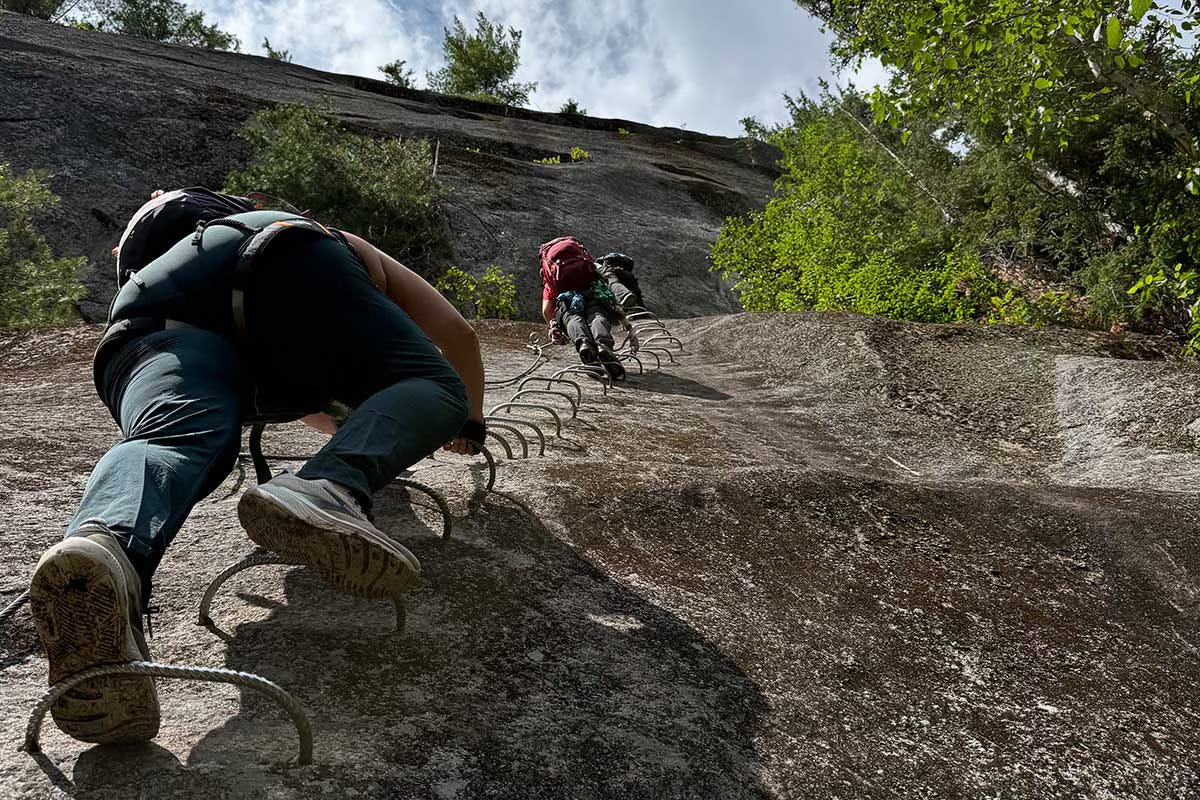
It turns out the via ferrata, or “iron road,” is basically rock climbing along a predetermined route, except you clip into a steel safety cable (or any of the iron rungs or holds) instead of relying on ropes and a belay. For three and a half hours, we were ascending a sheer cliff. Thankfully, I’d rock climbed before, so I knew to let my legs do the work so I wouldn’t burn out my arms and render them useless.
Our guide, a young, blond-haired, blue-eyed slip of a thing called “Ocean” who was just there for the summer, tested our group of eight on a small practice wall near the ranger station (our last chance to bail) and then ordered us into two groups. The faster group would start. Ocean would go next. Then it was me and my husband. Two twenty-something Quebec women brought up the rear.
I had spied them in the ranger station when we were filling out forms and hoped they’d be going with us. Unlike so many of the stereotypical outdoorsy types with lean physiques, these two women were obviously fit, but not skinny-minnies. You know. Like me.
Of course, I immediately did that thing where I try to assess whether my body is bigger or smaller than theirs (I’m still not sure how I actually appear in the world). In my mind, we were all about the same size, but when we tried on our harnesses and were instructed to tuck the excess straps into loops at our waists, I was the only one who didn’t have anything left to tuck. At that point, I hoped my years of athletic training would spare me from being the weakest link.
If these women were worried about any of it, they didn’t show it. They spent the entire four hours cracking jokes and singing loudly, channeling their best Celine Dion with “My Heart Will Go On” and other hits. It was like they were having the time of their lives.
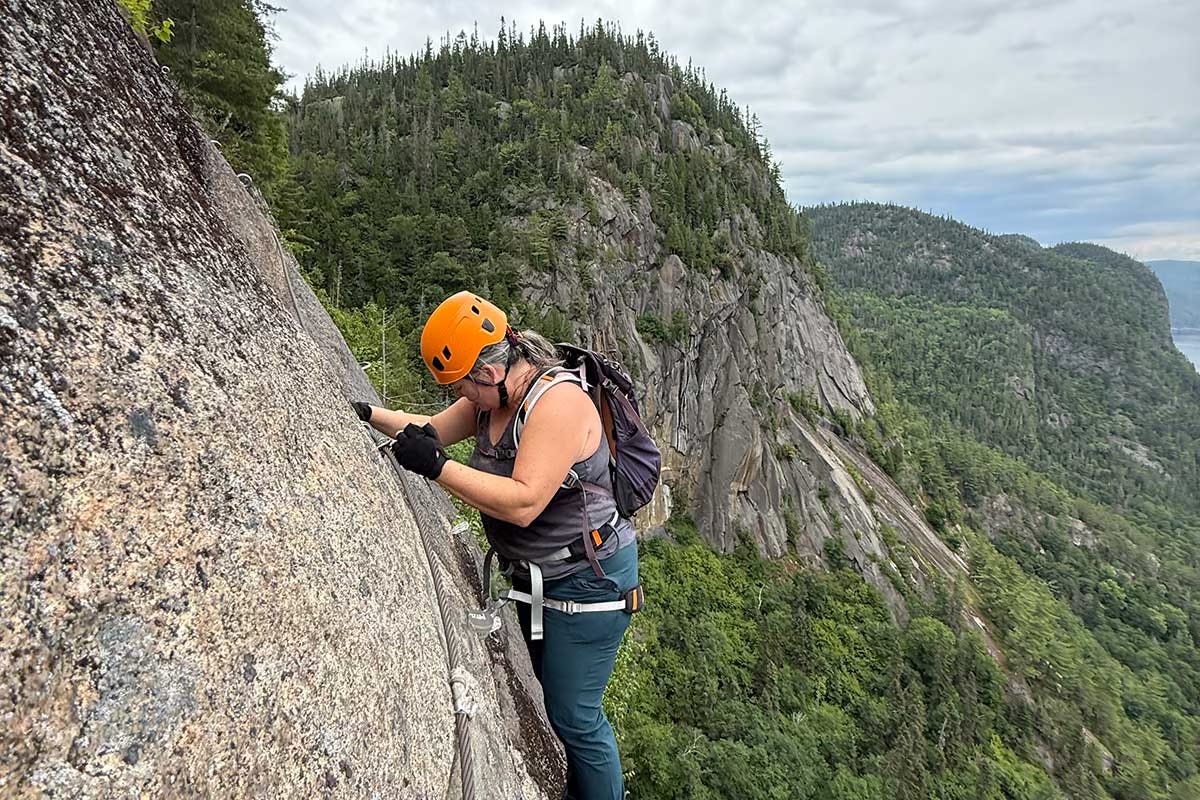
Meanwhile, I was taking this as seriously as a heart attack. Once I realized we were in for hours of actual climbing, not hiking, I was taking no chances. I was locked in, as my 17-year-old would say. Until I knew what I was in for, I would be expending no extra energy, especially not on things like talking or laughing.
The first section turned out to be an hour of climbing with almost no breaks, up, up, up a good chunk of the 650 feet along the cliff overlooking Baie Éternité. I looked down periodically and marveled at how the kayakers below got smaller and smaller until they were tiny little specks. Somehow, every time I looked up, there was more climbing.
I was moving at a turtle’s pace, methodically choosing my next move and making sure both carabiners were safely clipped in, before proceeding. I’d read later, after it was all over, that those clips would probably save me from death but not major injury if I fell. The holds we used to grip and stand on ranged in size, some as wide as a ladder rung, others maybe half the width of my shoe.
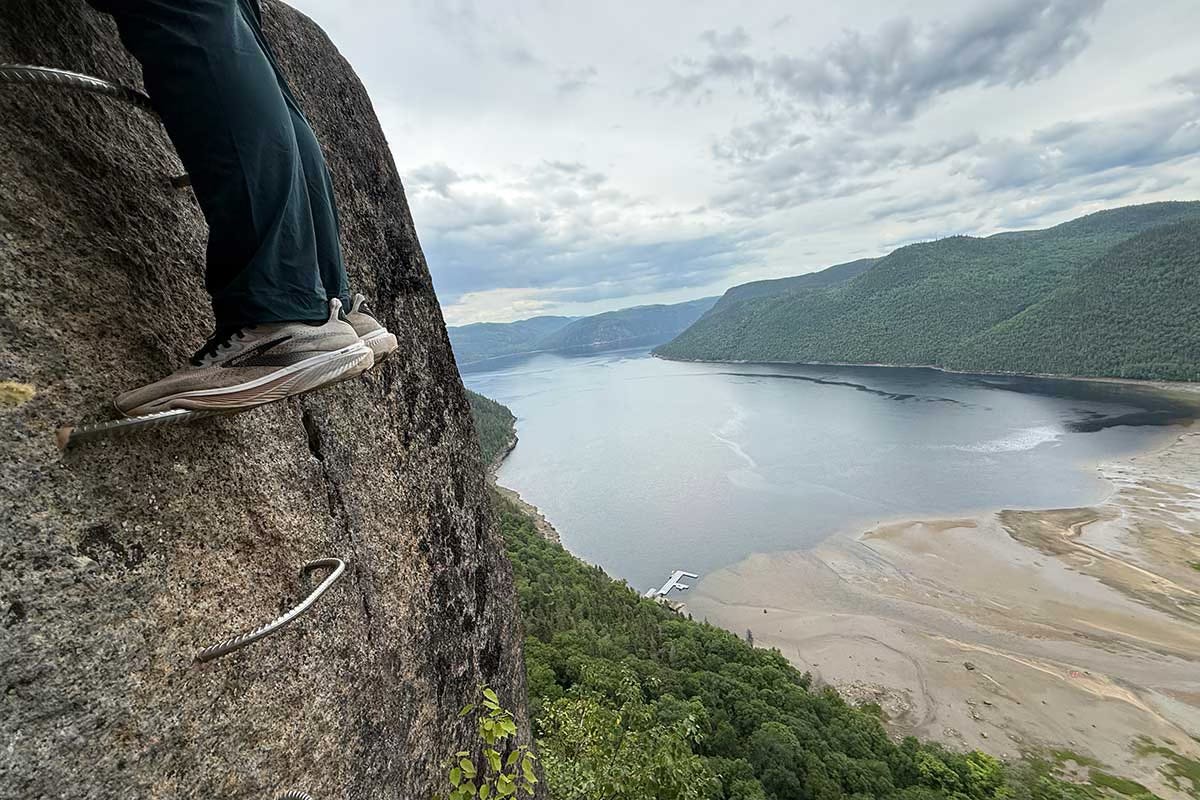
It didn’t take long to see why we needed the water. Despite perfect temps in the 60s, I was sweating from every orifice out of fear and sheer exertion.
When we finally stopped for a rest along a large crack in the cliff, my husband made his first crack about how glad he was that this hadn’t been his idea (he’s been using this line every time he tells someone about our adventure). I had gotten us into this, and I would get us—or, well, me at least—out of it. He was on his own, but he seemed to be totally fine. As a much taller person, he could move faster because his extra six inches of reach meant he didn’t have to stop and reposition his carabiners as often. I figured I was working at least a quarter harder than him. At least, that’s what I kept telling myself. He kept checking in every time he caught up to me, which felt like every few minutes, to make sure I was okay. I assured him I was just focused. I was creeping along, methodically choosing my next step with the precision of a brain surgeon.
Not for one second was I allowing myself the thought that I wouldn’t be able to do it. It would be way beyond humiliating to call it, but once we were already so high up, there would be no easy way down anyway. Our guide assured us this first section was the longest stretch, so I figured if I could survive it, I would be okay through the rest of it.
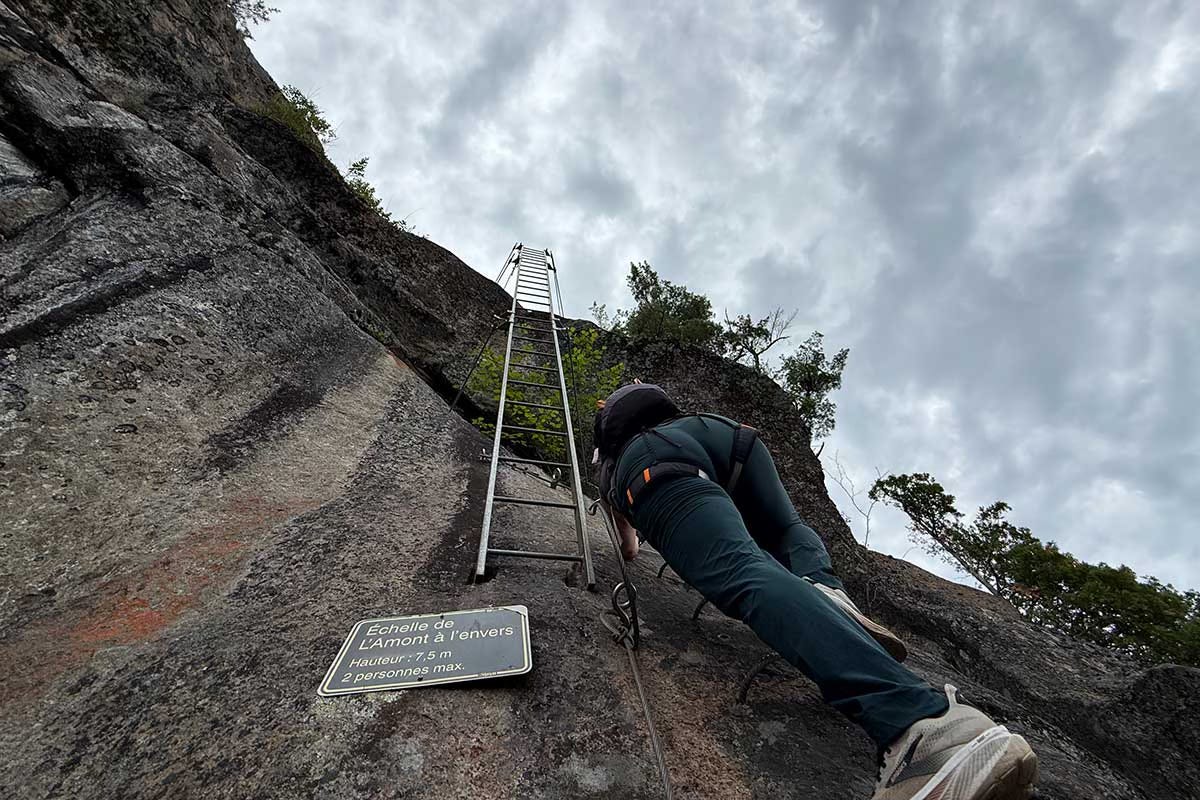
Except the first section ended with the one thing we had (actually, finally) read about: an inverted, 30-foot ladder we had to climb facing out toward the bay. Before I saw it, I’d pictured myself dangling from the cliff by my arms, Tom Cruise in Mission Impossible-style. So I was pleasantly surprised to discover it was an actual steel ladder that I could climb. It felt far more stable than everything else we’d done.
There were cheers for me throughout several sections of that first big stretch, and it seemed like I was the only one getting them. It’s because I’m fat and everyone is shocked I’ve made it this far was the thought running through my head. I quickly followed it up with, but these people don’t know me. They just see a very large woman doing this incredibly hard thing and have no idea all the things this body has already done. Maybe nobody was thinking that at all. Maybe they just saw how quiet and focused I was and thought I was struggling and needed encouragement.
I’m not sure the real truth would even matter. I wanted everyone on that cliff to see that a fat woman was doing the same thing they were. I needed to see it myself. And I would do whatever it took to accomplish it.
Once we made it through the first section and took a real break, I could relax enough to interact with other people. Our guide commented that people react to fear in different ways. Some get quiet and turn inward. Others get loud and start belting out Celine Dion.
I’d like to tell you it was all downhill from that point, but in fact, we had a couple more hours to go and several more challenges ahead. The first was a cable walk across an exposed gap in the cliff. I flashed back to tightrope walking at Miraval, where I’d learned the key was to try to postpone the leg shaking as long as possible, because once the shaking starts, it’s basically the end. I tried not to think and just kept telling myself, just keep moving, just keep moving, like Dory in Finding Nemo. Later, we had to do the same thing across a narrow wooden plank.
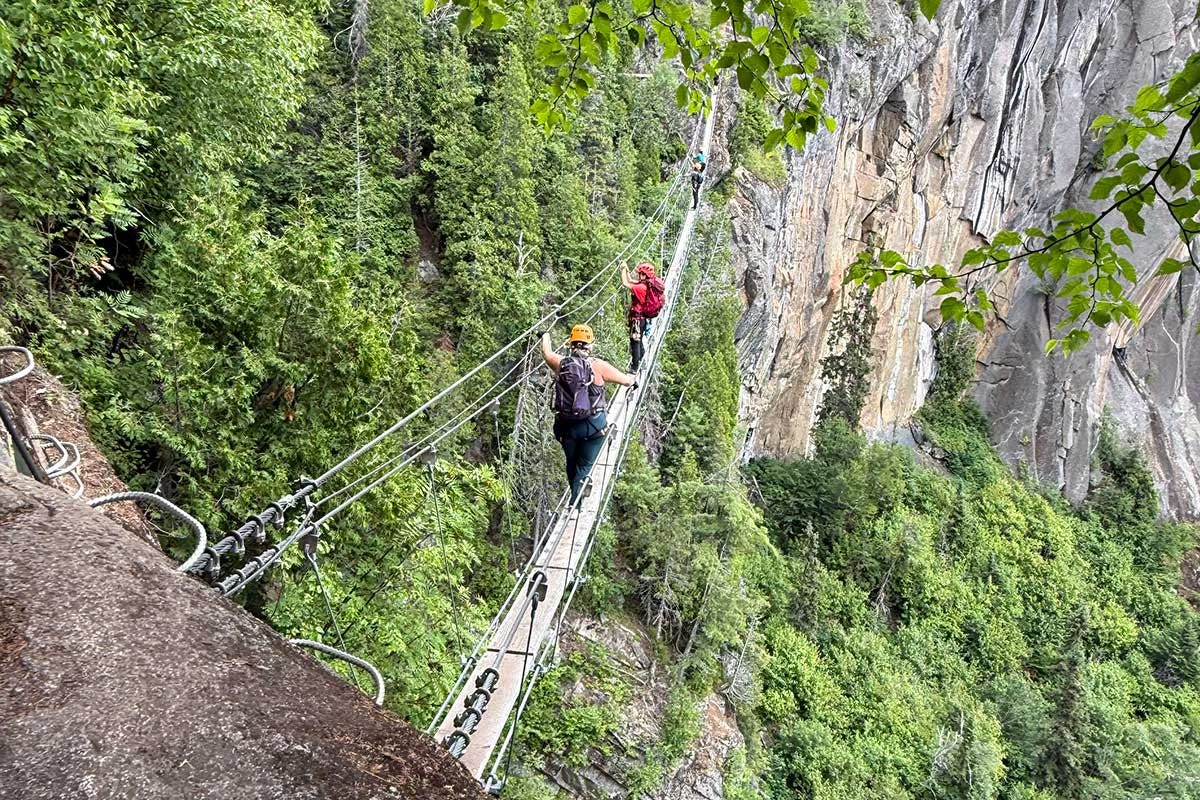
The final pièce de résistance was a 280-foot suspension bridge, one of the most iconic sights in the park. Ocean told us to space ourselves out as we crossed. She warned it would get harder and harder to clip in as we got closer to the middle, where our own movements would cause the bridge to shake more violently. Knowing this was the end, I relaxed enough to capture a panoramic video with one hand while keeping my other firmly on the bridge. It was the thrilling finale to our ferrata, and I could finally savor the views and the moment.
We took a rest break. My body was spent in a way that I could only compare to the two marathons I had completed three decades earlier. I wasn’t sure which was harder. My husband asked me whether I’d do this again, certain the answer would be no.
But it wasn’t actually over yet.
There was still a 30-minute hike down, some of which required clipping in and massive steps that caused my knees to bend way past the point of comfort. No walk in the park, this section was the most dangerous part of the whole adventure, Ocean warned us. Not from actual difficulty, I imagined, but because people assumed the hard part was over and naturally let their guard down. For me, the massive steps presented a bigger problem. They were brutal on my knees and my left Achilles, which had been nagging me for the past year.
I would do the ferrata again, under the right circumstances.
All these years since I quit diets, I’ve been trying to prove to myself and to the rest of the world that I could be fat and still do all the things I enjoyed doing before. And it’s true. I did and I could. My strong, fat body has carried me through one adventure after another. But for the first time, this summer, I asked myself: At what cost?
We’d go on to do the park’s signature hike the next day, a 4-mile, 1,100-foot elevation affair involving what seemed like a gazillion oversized steps to the Our Lady of Notre Dame Statue, one of Quebec’s icons. It was too much. My Achilles was a mess the rest of the trip. I could barely walk down the steps from the room of our second-story B&B. I pulled out the brace I hadn’t worn in nearly a year, determined not to let my ankle stop me from experiencing the whales and the rest of Tadoussac, but a decision was made.
I’ve been aware this whole last year, as my Achilles refused to get well, that something needed to be done. I’d suffered through it for more than a year, including months of PT that showed progress, but never enough once my activity ramped up, almost always when we traveled. I don’t think this injury is the result of living in a fat body. I think it’s the accumulated result of years of pushing through.
All these years, I’ve been trying to prove I’m the same person in this radically different body. Even as the world sees me differently. In the beginning, it was about proving it to myself, because I desperately wanted to keep doing the things I had always done. But somewhere along the way, it became more than that. It was proving to the world. To the haters, to the doubters. See this fat body? Let me show you what it can do. In a way, it had become just another version of what I’d always done. Trying to prove this body. Instead of simply accepting it.
I had proved it plenty throughout the years. Marathons, competitive Oly lifting, CrossFit, mountain biking, and more. But after I quit dieting and gained weight, it was like I had to prove myself all over again. I had begun collecting new evidence that this fat body, my fat body, was still strong. Still capable. Still me. And I was proving it to myself, yes, especially in the early days of this new me, but I was also trying to prove it to everyone else.
And I did it. I’ve unequivocally proven I can live in this body, a strong, fat body, and do more with it than most of the fucking planet. But until I was hanging off a cliff in the remote wilderness of Eastern Quebec, I hadn’t stopped to consider what all this proving might have cost me.
A lot of us do this, whether we’re conscious of it or not. Maybe not by climbing cliffs, but by pushing through pain or ignoring our bodies’ signals. We prove ourselves by “doing the work,” losing the weight, following the protocol, getting the procedure. We do it in the name of beauty, of youth, of fitness, of health. Rarely do we ask ourselves what all this proving, sometimes in the guise of improving, costs us.
In these endless quests and self-improvement projects, we lose sight of something fundamental: our bodies are worthy simply because they exist.
Most of us have done enough proving for one lifetime. We are allowed to live in our bodies just as they are. But there is a difference between understanding this intellectually and embodying it.
In my case, there’s still work to be done. This cliffside realization was just the beginning.


Holy crap!!! You had my heart racing and my hands sweating just thinking about that adventure. You are amazing! 😅
Can I just say . . . Never assume you know what the world is thinking of you. You might just be surprised that most of us aren't judging you. 😉
Damn, I think you've proven more than enough and that entire experience looks incredible! And here I was feeling proud of myself for taking three flights of stairs up to my son's apartment today when the elevator was taking too long 😂😂😂