


How individual are our “individual choices” about bodies, anyway?
I’ve been pondering this question the last few weeks, and really most of August, in light of the many conversations around the rise of celeb extreme thinness and its larger impact within society.
A few weeks ago, I wrote a piece that essentially outlined why I think we’re seeing this shift to the extreme, and how it’s driven, at least in part, by our need to preserve the existing social order. I wrote:
“French sociologist Pierre Bourdieu argued that status depends not simply in possessing something valuable, but in possessing something that remains difficult to obtain. As thinness became more attainable, it no longer held the same value. It wasn’t enough to just be thin. We had to be even thinner than we were before.”
Society’s status symbols are deliberately chosen by how rare they are. We see it with the latest “it” bag. We see it with bodies. With the proliferation of GLP-1s, society collectively perceives weight loss as more accessible than it once was, and so it naturally it had to become harder.
To be sure, much of this “pressure” (for lack of a better word because some of us don’t experience it as such) is subtle, subconscious, ingrained through the hundreds of thousands of messages we absorb through media and social media. The relentless critique of bodies and speculation of “is she or isn’t she on the drugs” amps up the sense that all our bodies are under scrutiny. It’s not just those in larger bodies who feel the pressure, but all of us, and women especially.
And there’s another rub: the perception that weight loss, this thing that so many of us have struggled with our entire lives, is now more easily attainable has strengthened the moral imperative to pursue it. If there’s an effective medication that can make you thinner, then remaining fat starts to look like a choice. A reckless choice. And, increasingly, one we feel entitled to judge, even in ourselves.
A few extra pounds is something we need to fix. The belly fat many women gain in menopause is a perfect example.
This isn’t because midlife bodies have suddenly changed. While the term “meno belly” is new, the biological propensity for women’s bodies and fat distribution to change during this phase of life is not. What has changed is the reference point.
It was clear from some of the comments in my previous piece that some readers missed my point, so I tried again. This time in Notes:
Most of the responses were supportive, but one stuck with me.
This woman wrote about how her identity had always been tied to being slim. Until perimenopause and chronic illness, she could quickly lose any weight she had gained.
She ended by saying:
“I know there are 4 inches that need to come off my waist.”
My first thought was: why need?
I’m not advocating that this woman shouldn’t lose weight or even shouldn’t want to lose weight. And she may very well have a legitimate medical need to lose weight. She should make whatever decision she feels is right for her body. I’m not arguing with that. I’m questioning need.
Because the reason the vast majority of us feel we need to lose weight is simply because society has conditioned us to believe fat is bad. So much so that we don’t even question it. Yes, there is enormous societal pressure to conform to beauty standards. And, no, it’s not vanity. There are legitimate, well-researched and documented downsides to living in a fat body, starting with how people in higher-weight bodies are treated. I understand anyone wanting to avoid that.
What I’m asking is that we take a step back and examine our own biases about fatness and where they come from. We aren’t born believing that a larger body is inherently worse than a smaller one. That’s a learned belief. It’s a reaction to the societal views and assumptions people make of higher-weight people. And these views have gotten worse over the last few years because of our heightened preoccupation with bodies and size.
I’m not asking people not to make the choice to lose weight. I’m asking them to pause long enough to consider where this individual choice comes from. Because that choice can still be ours while also being shaped by the culture around us.
These are some of the thoughts I’ve been coming back to this month. I’d love to hear your thoughts.
Here’s what else I wrote on Almost Sated in August
I shouldn’t have to prove what my body can do
This was the via ferrata story I promised last month. Hanging off a cliff in Quebec made me realize that since gaining weight, I’ve spent years collecting evidence that my fat body is still strong and capable. At some point, proving that to myself became needing to prove it to everyone else. Maybe I’ve finally proven enough.

The place that made us rethink our next chapter
I wrote about how our time in Ithaca this summer shifted the conversation my husband and I have been having about where we want to live after our daughter graduates. We came home with a much clearer sense of what we want from the next chapter and a new list of places to explore.

One thing I’m loving this month
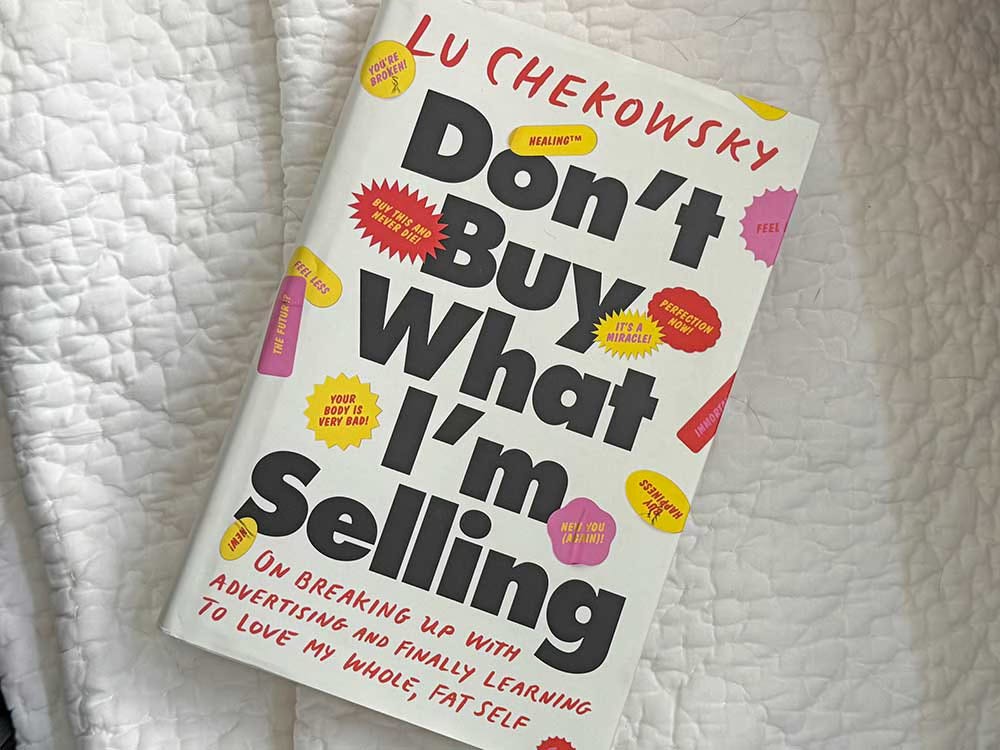
I’m reading Lu Chekowsky’s Don’t Buy What I’m Selling (thanks to Vanessa Scaringi, PhD for the recommendation), and it’s exactly what I needed. Funny and heartbreaking and revelatory at the same time. It’s not a body image memoir so much as a memoir in which the body shapes how one woman experiences ambition, grief, love, lust, success … basically every aspect of her life.
Through the book, Lu explores her overwhelmingly successful career in advertising, complete with scintillating behind-the-scenes tales from her work with big names in Hollywood and even bigger brands. Woven through all of it is the loss of her mother. Lu’s relationship with food and her own body is ever-present, but remains almost a shadow figure until nearly the very end.
I’ve got a couple more chapters to go, but this was the line I felt in my core:
“Maybe I didn’t have to become a whisper of a woman to be an ‘after.’ Maybe I could become a roar.”
The rest of August
It’s still hot in Texas. In fact, we’re in the height of the hotness, but I’m past the worst of my summer affective disorder because I can finally see the finish line. Cooler days are coming. You know … after Halloween.
I’ve also been confined to a boot for the last two weeks as I work through a procedure I had done on my Achilles, so my exposure to the outdoors has been pretty limited.
I’m looking forward to getting back on my mountain bike soon, but I have to admit, it’s been kind of nice to have a legitimate reason to stay inside, slow down, and write. If there were ever a good time to be stuck in a boot, it’s Texas in August!
Looking ahead
September feels like a continuation of several conversations that started this month.
I’m still thinking about extreme thinness, how much GLP-1s have changed the cultural landscape around weight, and all the ways our increasingly intense focus on bodies is making us more aware of our own.
I also keep coming back to menopause and the assumption that every physical change that comes with aging needs to be resisted.
I think this is the theme I’m carrying into September: getting more curious about the things we’ve been taught to accept as obvious.
A question for you
When is the last time you stopped to question something you thought you “needed” to change about your body?
Maybe you still decided to change it.
Maybe you didn’t.
I’m less interested in the decision than in what happened when you stopped to ask where the desire came from.
I’d love to hear what you think.
I have been wondering what your thoughts are on the book rec!! So glad you are enjoying it. The quote that resonated struck me too. It was also lovely to run into you last week:)
It's really interesting that our culture (at least in America) believes bigger is better ... except when it comes to women's bodies 🤔 I really appreciate how you're digging below the surface here and asking us to question where the belief that we need to be smaller and lose weight came from. I read a book in college that gets to the root of why so many women end up subconsciously believing that we need to be smaller. (I actually ended up writing my thesis on the topic), it's called Can't Buy My Love: How Advertising Changes the Way We Think And Feel.