


Like the rest of the planet, I’m currently spending an ungodly amount of time thinking about Lindy West.
I’ll admit, somehow I had been sleeping under a rock, and despite her being a fat person who writes about being fat (I’m using fat here and throughout this piece as a neutral descriptor), I had not heard of her until last week, when she was suddenly everywhere. In my group texts. All over my Facebook feed. In Substack posts. On Notes.
People dissecting her marriage, her choices, whether she was cheated on or agreed to something she didn’t actually want, whether her own words are her actual truth or just a fiction she’s told herself, whether she’s somehow single-handedly brought down feminism.
I picked up Adult Braces to see what the fuss was about. What clinched it for me was more simple: a memoir-slash-travelogue written by a fat feminist. Of course, I wanted to read about her polyamorous ultimatum/existential crisis, but what I actually came for was her relationship with her body.
Her body is more of a backdrop in this book than the many landscapes and camps she writes about rolling through in her rental travel van. But what struck me most in reading Adult Braces is how much her body does not fully belong to her.
She writes about realizing, early in childhood, that her body is something separate from her. Open for commentary.
“One by one, the people around me let me know that my body was bad. They were varied in tone but unified in message. I fractured and began to leave my body.”
As she becomes more famous, that ownership shifts from people who judge her to people who see themselves in her and people who feel invested in what she does with her body:
“To fat people, fat women especially, I became theirs—an investment born from love, need, shared trauma, relief, belonging. I was owned by a different segment of the public now. Ones who loved me instead of hated me, but still. I felt, in a strange way, parental: devoted and awed and flooded with love, but also flattened and erased and eaten up. I took this step, I made myself mean something, I offered my relationship with my body as an example and a lifeline. And I profited from that. Why would those fat people, who mean so much to me, who are RIGHT, not wrong, about themselves, not feel some stake in what happens to this body?”
I find it fascinating to compare and contrast because I’m still trying to make sense of living in this larger body, after many years of intentionally trying to shrink myself. I haven’t had Lindy’s experience. And I don’t mean in the public, fame-driven way, but not even in the other public everyday ways I’ve heard people experience fatness.
My body still largely feels like it’s my own. Perhaps that’s an illusion, but I haven’t yet experienced the kind of public shaming that many fat people speak of.
I’ve never had a stranger make a negative judgment about what I’m eating or what I’m putting in my grocery cart because of my weight. I’ve never had a doctor recommend weight loss. I’ve never felt like my body was something the world had full permission to speak on.
This is a phenomenon I’ve wondered about long before Lindy. I don’t seem to get the kind of commentary other people like to dole out to fat people about their bodies, and I spend an ungodly amount of time wondering why.
I think a part of it is this:
I still pass.
Probably not to my size 6 friends (or even to my size 8 and 10 friends). But to the world at large.
Part of me thinks people are too afraid to say anything. I joke it’s because I give off don’t fuck with me vibes (finally, a benefit to everyone thinking I don’t like them). Maybe it’s part of my “low affect.” I had only one stranger touch my belly throughout three pregnancies.
Or maybe it’s how I carry myself that makes them hesitate. I am strong and muscular and fat. Like I could squash you like a bug if I needed to. And I truly believe it. There’s a huge confidence that comes from knowing my strength. Even if I have a sliver of the strength I used to have, it’s still more than most. And I think that confidence shapes how I am seen in this world.
I want to be clear: I am not saying that if you’re getting “should you be eating that?” questions from a stranger, you’re not confident enough.
I think there’s a tipping point with your weight where the world—or at least, the worst of it—feels fully entitled to say those things. I’m fascinated by those people, by the way. The lowest of the low. What makes them think they have the right to say anything at all about someone else and their choices?
But I guess I’m still questioning where I fit in all this.
After I published my piece Going fat in the time of Ozempic a couple of years ago, I was politely asked whether I was throwing the term fat around as it relates to my body and whether I actually consider myself fat or even qualify as fat. (For the record, I was using what I felt was the correct description.) It was from another writer here on Substack, and after reaching out to her privately, she sent me some social media posts she had created that outline her criteria for determining your level of fatness.
I deliberated and then determined I was still fat, though perhaps on the very smallest end of the spectrum. But I still question that now, because I have not experienced the level of discrimination many in larger bodies have.
Plus, let me just say, I’m just as triggered when I see those “midsize” influencers who are maybe a size 10 bemoaning how nothing looks cute on them. I’m like, fucking please. You have probably 50 times the availability of clothing as I do in my size 16-18 body. So I totally get people in bodies larger than mine saying the same thing about me.
For the longest time, what I’ve felt is that I’ve been straddling the line of thin privilege. Some days, I feel like maybe I’m still midsize, which is funny, because that’s what I was before, back in my dieting days, when I weighed much less and felt fat but didn’t actually experience a world that wasn’t optimized for my body. But lately I’ve been thinking I’m in this weird sort of no man’s land, where I don’t really feel like I fit anywhere.
I wrote last week about the trauma of taking your seat on an airplane and holding your breath as you wait to see if the belt is going to fit, and how much your body is going to press against the armrests and the people next to you.
This weekend, I brushed up against it again.
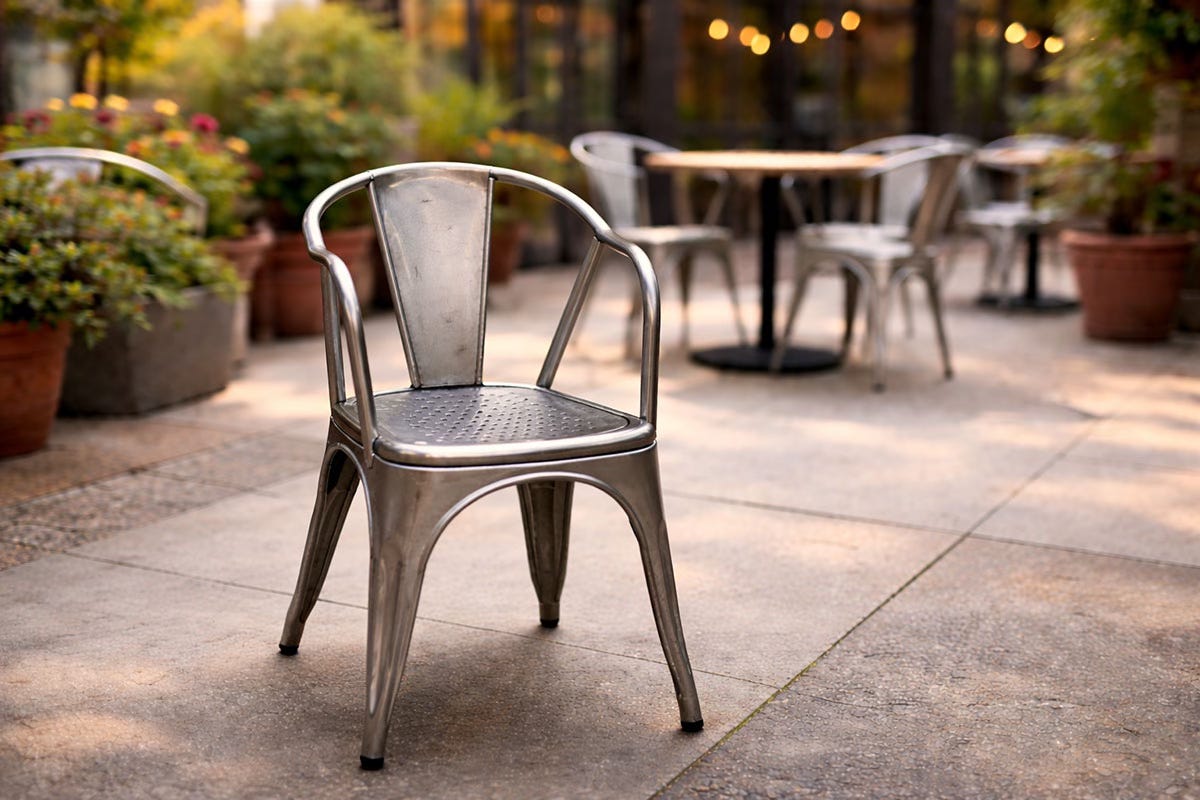
I sat down to brunch with my husband and friends after a three-mile hike in Texas’ Hill Country at a nearby winery. I slid into the chair and immediately felt it. The metal sides pressing into my glutes. It was beyond airplane-seat discomfort.
I tried adjusting without making it obvious. Shifting forward in the seat. Leaning all the way back. I casually raised and lowered myself a few times, hoping I could brute force my butt into a more comfortable position. No luck.
Eventually, I realized the only option was shifting my hips so that one side angled forward while the other remained back, then I twisted my waist so I was still facing straight on. Looking around the table, I concluded I was the only one having this problem. I should have just asked. If it had just been my husband and me, I would have.
The whole time I was thinking: how the fuck did this place pick such uncomfortable chairs? But I said nothing. Score one for not thinking it’s my fault. Zero for not speaking up.
So maybe I’m not as confident in this body as I think. Certainly no poster child for body positivity.
Lindy writes about that burden of expectation in being a famous fat person:
“I had to love my body unequivocally, forever, exactly as it was, or else.”
I’ve never had that illusion.
Certainly, there are moments where I perform. I’ve put on a cheerful face about these deliberate choices I’ve made to no longer restrict, even while struggling internally. Part of it is I’ve learned in this experience of giving up diets, that feelings, especially uncomfortable ones about my body, don’t actually have to be acted upon in realtime. Feelings are fleeting. But I know my reasons for not restricting, and they don’t go away.
I also know that who I am now is not who I will be forever. This relationship to myself will shift with time. I’m not holding myself to permanence. This includes my body, which is meant to change. And if anyone else does, that is disappointing, but also, on them.
As for actual positive feelings about my body, I have occasional moments of them breaking through, but mostly I feel that it’s impossible to feel positive about something half the Western world has been trained to hate about themselves. This phenomenon of women collectively hating their bodies is so prevalent it’s even got a name: normative discontent. My intuitive eating therapist told me early on the goal wasn’t body positivity but body neutrality. That your body, and your feelings about your body, take up less mental space. I still think that’s the goal. It’s certainly the one I most wish for my children.
My progress in healing my relationship with my body depends on my honesty with it. And the honest truth is sometimes I feel like shit in it. Sometimes I’m okay. And sometimes, I not only understand my life would be easier if I were smaller, but I wish for it too.
So I exist somewhere in between.
Between feeling fat and being seen as fat.
Between claiming it and questioning whether I’m allowed to.
Between comfort and discomfort.
Between passing and being seen.
I’d love to hear your thoughts …
Who else is reading Adult Braces? What parts have stuck with you? What else is on your mind?
Kristi, thank you for another excellent, perspective-widening essay. As I was reading I was thinking that you likely carry yourself differently because you are fit and strong...then you wrote that exact thing. Being fit and strong gives us a certain energy, a physical and mental edge that go beyond the obvious benefits of exercise and that 'special something', in your case the strong vibes, is noticeable in the way a person carries themself and how they feel - just as the lack of it is also noticeable. While I am a thin person I have wavered between being fit and decidedly not fit many times in my life and it feels very different. I hope this comment makes sense. I was wrestling with the words trying to get it to come out right.
I love that line about crushing them like bugs!