


In my sister’s bathroom is a framed photo of our 1983 YMCA soccer team. I’m 8. She’s 7. Only one other face is familiar to me now.
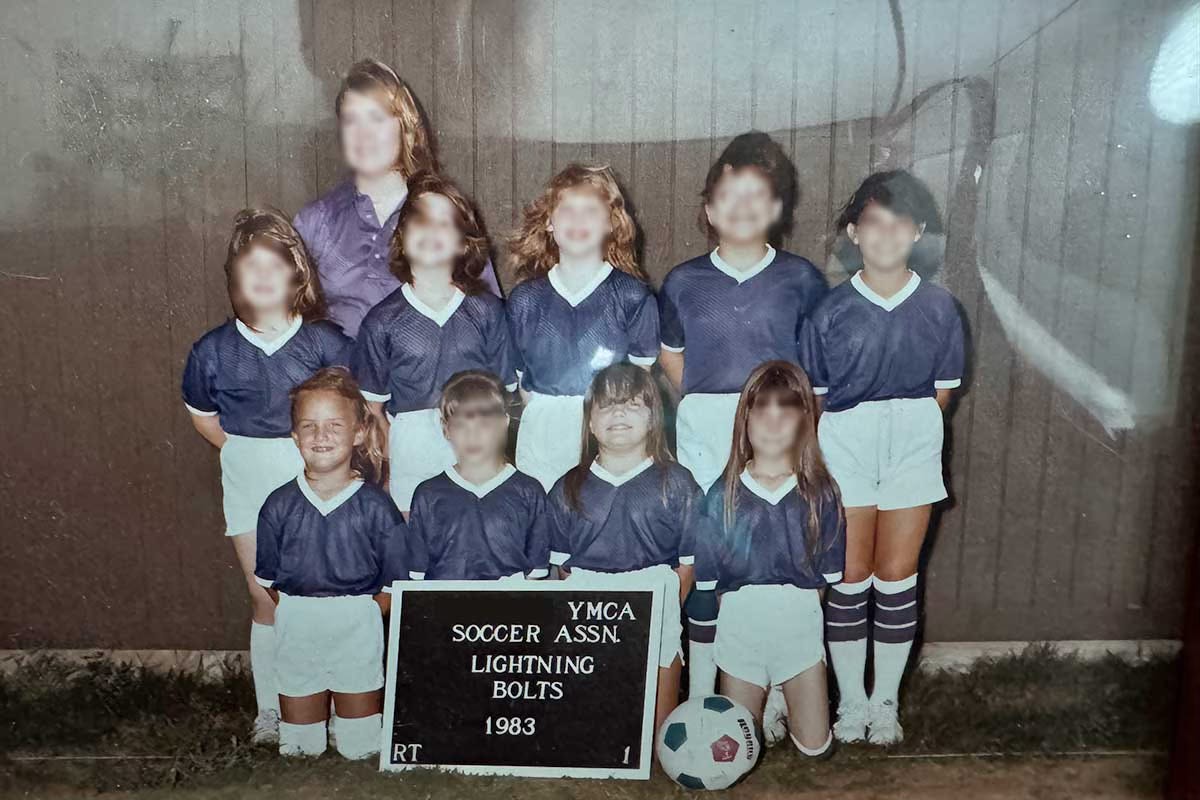
I’ve never asked why it’s framed or why it’s sitting on a shelf in the bathroom, probably because asking would mean drawing unnecessary attention to myself, or rather to the little girl, who I see so clearly now needed protection.
I pause on that picture every time I pass it.
I passed it a lot in January, when I flew out to help my sister recover from shoulder surgery. Every time I look at myself in that photo, I go back to that time and place, and sit in that little girl’s shoes for a moment.
By the time it was taken, I had already absorbed the idea that something was wrong with my body. I felt so different from all the other girls, so much larger.
I hated having my picture made, especially the team photos, because there was no hiding. With us standing shoulder to shoulder, everyone looking at the photo would see how wrong my body was.
The roots of athletics
My sister and I have had a lifetime of athletic pursuits since then. She was the real athlete, that’s what I told myself for years. Even at the rec sports stage, she excelled in every sport she played: softball, basketball, soccer. She was also thinner than me. Narrower. Leaner.
Somewhere between the ages of 8 and 12, my dad caught the golf bug and went “all in” on the idea that one or both of us should become professional golfers (my sister and I both share his trait of going all in on things). He built a real putting green in the backyard of our otherwise blue-collar house, complete with a sand trap that our cat promptly used as a litter box.
My dad made us putt to see who did the dishes after dinner. Almost every night, he’d haul us to the high school we’d later attend with a shag bag and have us hit balls over and over, interrupting us every few shots. “Now, y’all lookie here…” or “Are y’all lookin’ here?” he’d say mid-swing, demonstrating what we should have been doing, his East Texas drawl in full effect.
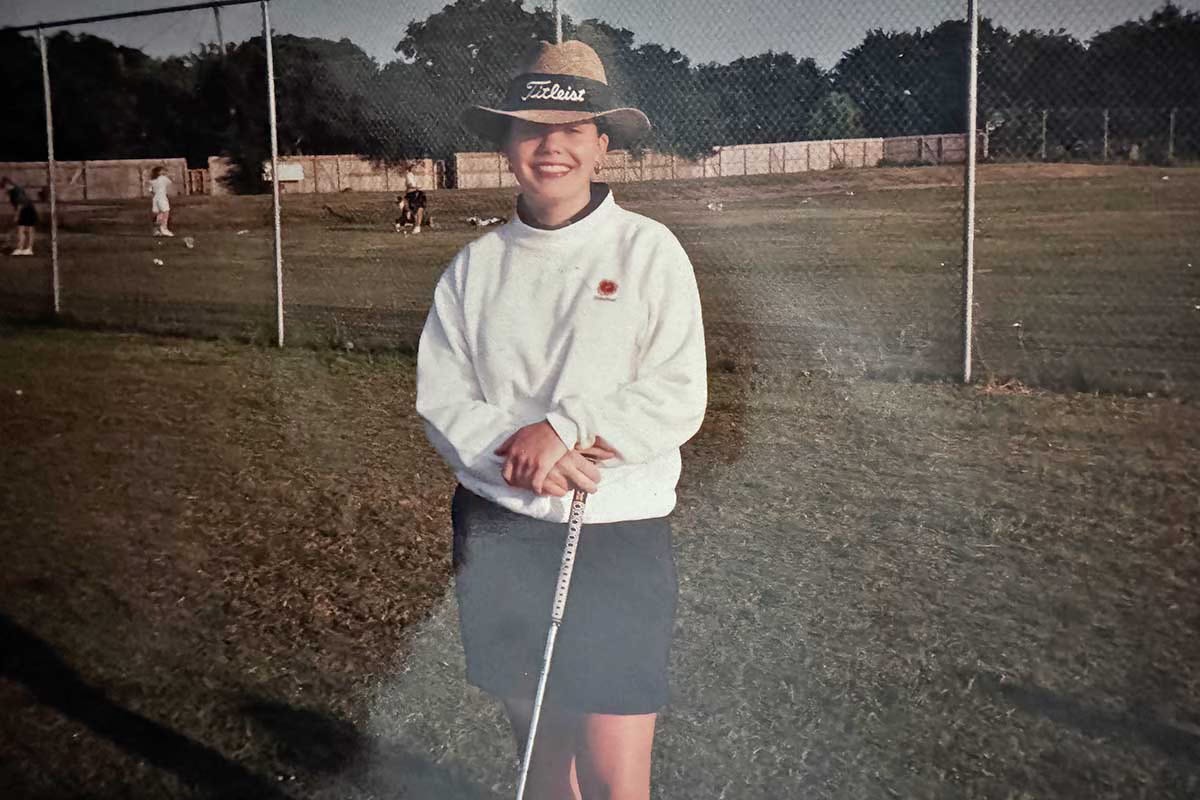
We started playing tournaments in middle school and continued through high school. My sister went on to become a pro, working at the famed Wailea Golf Club in Maui, before giving golf up entirely after my father died. She took up surfing, and went all in on that, creating a foundation that gave away surfboards to impoverished children around the world, which allowed her to surf wherever she went. Then she discovered mountain biking, which she introduced me to on a trip to Austin in 2019. We’ve been riding ever since.
Finding strength my own way
I had my own path with sports and athletics. I wasn’t nearly as gifted at golf as my sister, but with expectations so high, it felt like anything less than greatness was failure. Now I see I was pretty good. Many would argue I had the better swing, but my focus was always on academics, so I focused on college and went on to become the first in my family to get a degree.
With my sister’s star so bright, I thought I wasn’t athletic, but I found my place. A strength training class in college with the renowned powerlifter Dr. Jan Todd, featured by the New York Times back in May, introduced me to my natural gifts in strength.
I leaned into it, picking up a personal training certification in my early 20s along with my journalism degree. For years, I worked part-time as a trainer alongside my full-time newspaper job. I dabbled in plenty of athletic pursuits alongside lifting: running (including my first marathon in college), then spin, CrossFit, and Olympic lifting, which carried through most of my 40s until my sister introduced me to mountain biking.
My athletic pursuits were always about pushing myself, testing mental fortitude.
They were also about training, and taming, my body.
Undoing the damage
I stopped intentionally trying to shrink myself in August 2022, taking up intuitive eating, and beginning the process of undoing the damage I’d absorbed over a lifetime of trying to shrink myself. Realizing this wouldn’t be fast or easy, I found an intuitive eating-certified therapist who helped me uncover my wounds and heal.
I’ve come a long way.
These days, when I stare intently at the picture of that little girl, I see her through different eyes. It’s true, I wasn’t slight or lithe. I was broad but somehow compact. A powerhouse! If I had only seen my body for what it was.
Curiously, the thing that jumps out at me is that this wasn’t a sea of tiny bodies. There were taller girls and bigger girls than me. We were all different, but also not all that different, so why did I feel so intently I was the problem?
I almost faltered in December
I’ll admit, I almost faltered this holiday season. After a string of hard days, I made the decision to talk to my doctor about GLP-1s at my upcoming checkup in a few months. She’s HAES-aligned (Health at Every Size), one of the few doctors who doesn’t prescribe weight loss or weigh people unless medically necessary. She also knows my history of disordered eating. I found her through a friend of a friend, and it just so happened that her office was 10 minutes from my house, which was truly amazing given how few HAES doctors there are. Then I waited almost a year to get in to see her.
In my weak moment, I wasn’t thinking I want to be skinny. It was more like, I just want to lose enough weight that I can move my body with more ease, enough that I can walk into most stores and feel confident something will fit me. I wasn’t asking a lot. I wasn’t chasing my size 12 days when I felt fat but really wasn’t, I just wanted to lose enough that all 16s would fit.
I had gotten it in my head that my husband noticed me more at the beginning of our relationship, when I was smaller. Never mind that my husband has always loved curves and always made it clear he’s found me sexy at all my sizes.
In all this rumination, there was one thing I was sure about: I wouldn’t go back to dieting. At least not without help. This time I’d do it differently. This time I’d do it without obsessing over numbers, laying awake at night calculating and recalculating what I’d need to cap my calories at for the foreseeable future to see meaningful results by a certain day. This time I wanted to lose the weight as slowly and with as little anxiety as possible. And I believed it was possible because I finally understood: it wasn’t really my body that was the problem. It was this damn society we live in that’s obsessed with thinness.
My doctor would be able to tell me which medication would be the safest to take for the rest of my life, with the least amount of side effects, and the most gradual results. Basically, I was just looking to take the edge off. Just get me back to a societally acceptable-ish range, which would still be larger than most of my friends and definitely still too big for Paris. But enough to be okay.
What diet recovery really looks like
During the first few months of quitting diets, I worked through the stages of grief. I grieved over what my body was now, and what it would never be. I raged over the years I’d wasted on restrictive behaviors and calorie counting. I lamented the many periods when I prioritized exercise over my actual health, training through flu, injuries, and obvious signs my body needed a break. I raged over the years I’d believed my worth was tied directly to my size.
But I spent most of that time in the bargaining stage. Could I still restrict a little, just enough to see results but not enough to obsess? To lose just enough to have more clothing options? I always came to the same conclusion. The answer was no, I could never go back.
But this time was different.
While I wasn’t taking action, no “last supper” feasting, no “diets starts tomorrow” thinking, I believed a decision had been made. I just wasn’t taking immediate action. It’s like I needed the idea to simmer. Just to be sure.
Aging, health, and the messages we inherit
From the time we’re born to the time we die, women are inundated with messages about our body size and worth. As we get older, the body messages become about health and longevity. We want to live as long as we can and as well as we can, but navigating how to do that in a world of unrelenting products and solutions and shoulds becomes a minefield.
During my stay with my sister, I started reading Deb Benfield’s “Unapologetic Aging” as a preview for an upcoming interview (which we did last week). The book offers a nuanced take on diet culture through the lens of female aging. We’re not just combatting the messages to be thin, we’re combatting the messages that we should never show signs of aging in the first place.
You could say the book came at the right time. It reminded me why I quit diets in the first place.
I recognized myself in her anecdotes, one in particular, where she explained why you can’t judge someone’s health by appearances:
“I once worked with a client who could not buy clothing in most stores and whose personal trainer told me she was the most fit client he had ever worked with.”
Somehow just seeing myself in her words had a calming effect. I told her so in our interview and explained the narrative I used to have about myself.
Even as a lifelong athlete, it always felt like something was wrong with me because of my bigger body, so I spent years trying to prove myself. I lived by the motto, If I can’t be small, let me be strong. But even still, until I quit dieting, I couldn’t shake the belief that my body still needed fixing.
Today, on my worst days, I see very clearly the problem is not my body, but a society fixated on thinness.
Benfield agreed:
“When you’re in recovery [from diets], when you leave treatment, you walk into a world that is inundating you with all of the dysfunction. My analogy is, it’s like coming out of rehab and living in a frat party where everybody’s partying.
Everybody is talking about dieting. And to me, that’s the issue. The through line for me is restriction and drive for thinness. And if you have to be exposed to that all the time, then it’s very difficult to fully recover and to feel comfortable in your body.”
If I could talk to that little girl now
Healing body trauma is a long road. I’ve come to accept I may never be fully healed—not because there’s something wrong with me, but because of the culture we live in, the messages that say we’re never young enough, never thin enough. What I know now, deep in my core, is that my worth has nothing to do with my size. It took me over 40 years to get here. And I have to keep reminding myself, because the world keeps trying to make me forget.
I wish I could go back and tell that little girl that she didn’t need fixing. That there was nothing wrong with her or her body. She was just fine the way she was.


Thank you for sharing your powerful story, Kristi. I have no doubt, this will resonate with many and hopefully remind others that recovery and liberation from diet culture is not only possible but so worth it. Thank you for including me and my book!
Beautiful! I always appreciate your honesty and vulnerable take on our dieting culture.