


This is the third installment in my holiday series, Gifts to Yourself: A Holiday Season of Letting Go, where I explore small, meaningful ways to bring yourself peace during a season that’s often anything but. So far, I’ve written about the gift of being unapologetically yourself and the gift of opting out of body talk. Today’s piece builds on those themes with another offering: the gift of a better relationship with food and body.
If you’re finding this series meaningful, consider subscribing so you don’t miss the rest. There’s more to come, and I’d love to have you along. 💙
Why this season stirs so much up
Navigating food and body image issues is tough this time of year. Even those of us further along in our body liberation journeys can get off course. The holidays have a way of stirring up childhood memories, old wounds, and worn-out narratives we thought we’d left behind. Layer on the usual stressors like family dynamics, social events, what to wear, how to show up, and the pressure ratchets up quickly. Many of us don’t register the pressure consciously, but our bodies do. I carry most of my tension in my shoulders, and this time of year, it feels like they’re inching higher and higher with every new stressor. It’s my call to take care.
Before I found intuitive eating, I thought I had a problem with food. I thought I lacked willpower. I thought something was wrong with me and my body. Why was I always hungry? Why was I constantly thinking about food? Why did my body not look like the others around me? The blame game was in full effect, and it was always aimed at me.
These days, my relationship with food looks different. Kinder, more forgiving. It’s not perfect, but that isn’t the goal anymore. My relationship with my body is better too. It’s still complicated at times, but that feels like a reasonable response to living in a world that’s deeply messed up about bodies and food.
It’s a confusing time to talk about body image
Many of us, especially women in midlife and beyond, came of age during the height of diet culture. We were there sitting in front of our television when Oprah wheeled out her 67 pounds of fat, the first of her many “new body” reveals. We related to the struggle and longed for that same triumph, so we climbed aboard the diet wagon alongside her (again, and again, and again), totally buying into the idea that it was somehow our fault that the weight loss never stuck.
Body positivity as a pop culture moment, aka that Dove campaign and all the hashtags, came later. And if I’m being honest, it often felt like it belonged to a younger generation, women who hadn’t lived through decades of diets, shame, and internalized scrutiny. But it cracked something open for a lot of us, a small window to let some of the baggage go.
Thin is trending again, and everyone feels it
Now, the cultural conversation has shifted again, and not in a good way. Thin is in, and though it never fully left, body acceptance feels further out of reach. And we largely have the marketing and media coverage of GLP-1s to thank for it. Though fewer than 15% of Americans have tried a GLP-1 for weight loss, the discourse around them has taken over a disproportionate share of our collective mental space. I think sam baker said it best: Mounjaro has turned the weight loss noise up to 11. (And, no, I’m not against taking a GLP-1 for weight loss or health reasons. We all have to make the right decisions for ourselves.)
But what’s more damning is how it’s shifted the bounds of decorum and decency when it comes to our bodies. In certain corners of the culture, they no longer feel like our own. And it goes both ways. If you live in a larger body, just boarding a plane can make you a target for public scrutiny. But you can’t be too thin either. Just ask Ariana Grande, who shared her own “loving reminder” about body shaming this week. Our bodies have become part of the public domain, open to judgment, commentary, and scrutiny. Especially for the largest among us.
There’s probably never been a worse time to be a person in a larger body, given all the open hostility. But make no mistake: no body is exempt. And it’s this cultural noise that ends up spiraling into the internal judgments we carry with us. I certainly don’t have all the answers, and it’s a complicated issue when weight intersects with health. Again, we all have to make our own choices about how to best take care of ourselves.
Where I’m finding support right now
A few weeks ago, I attended a Texas Book Festival panel called The Illusion of Better: An Exploration of Sickness and Self-Care, featuring Mallary Tenore Tarpley, author of Slip: Life in the Middle of Eating Disorder Recovery (a must-read for those in recovery or caring for loved ones in recovery—here’s my my review of it), and Amy Larocca, author of How to Be Well: Navigating Our Self-Care Epidemic.
They spoke about recovery in a culture obsessed with thinness and referenced the concept of normative discontent, a term coined in the 1980s to describe widespread body dissatisfaction among women. Basically, hating our bodies has become such a standard part of the female experience that it’s seen as the norm. Liking or even accepting your body puts you in a small minority.
I don’t share all this to be a downer but rather to say: If it feels like the pressure to conform to body image norms is even higher right now, you’re not imagining it. Not loving our bodies in a culture that promotes (and profits off of) our self-loathing makes perfect sense. And yet, there’s still so much value in giving ourselves the gift of a more compassionate relationship with our bodies … yes, just as they are right now.
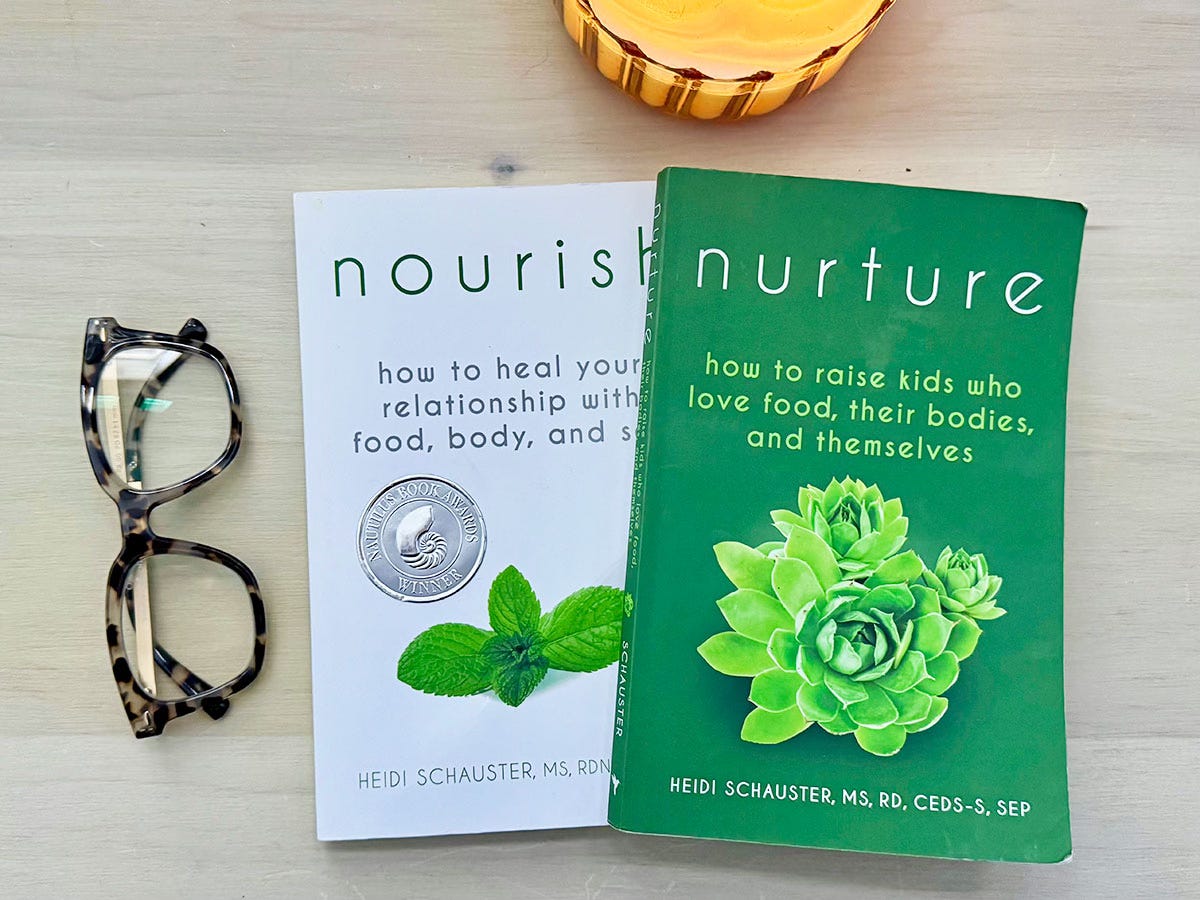
One thing that’s helped me lately: revisiting two compassionate books by dietitian and eating disorder specialist Heidi Schauster. Nourish and Nurture aren’t brand new (the latter published in 2024), but they feel especially relevant.
These books aren’t about hard rules or quick fixes. Think of them as gentle invitations to expand our capacity for building easier relationships with food and body. Nourish helps us rethink how we approach our own relationship with food and body, while Nurture gently guides us in supporting our children so they build a healthier foundation around food and self-esteem. While there is some overlap between the two, there’s value in reading them as a pair if you’re a parent.
As Schauster writes in Nurture:
“Body acceptance is the balm that can bring attention back to what is meaningful in one’s life.”
It’s a powerful statement, one grounded in presence. There’s peace that comes when we stop waging war on our bodies and start reclaiming our time, energy, and mental space for things that truly matter.
3 reasons why Nurture and Nourish feel like gifts
1. They dismantle shame.
Schauster doesn’t preach or pathologize. She normalizes the struggle. You are not broken. The culture is. And yet, healing requires us to show up again and again, to unlearn the harmful narratives we’ve absorbed and replace them with ones that nourish us and the people we care for.
She writes in Step 2 of Nourish (“Respect and Speak Well of Bodies, Including Your Own”):
“Don’t we all wish for our kids to know the truth—that, deep down, you (and they) are the same beautiful people, despite body fluctuations? The only way to communicate this truth is to be more neutral about weight and body size for yourself and others. Treat it like eye color, and don’t attach any morality or virtue to it.”
2. They offer gentle structure for change.
There’s gentle guidance to help parents give up dieting or food restriction (unless medically necessary) and model greater acceptance of all body sizes. And it’s backed by research but not dense. She covers why body size isn’t always determined by how much we eat, why diets don’t work long-term, and how we can unknowingly create a more “charged” eating environment, along with a food scarcity mindset, when we demonize foods.
She doesn’t sugarcoat the challenges, but she does offer a path forward, with best practices around feeding, eating disorder prevention, picky eating, navigating social media, and establishing real self-care, for both kids and the adults raising them.
3. They center compassion.
Schauster acknowledges food’s role as both comfort and care, but makes clear it should not be the only way we cope with life’s challenges. She makes an impassioned plea for learning to recognize and tolerate emotions in order to build resilience.
“If you “numb” out with food or food restriction (or anything else), then you may be missing out on expressing emotions, meeting the needs underneath, and seeking out other ways to meet those needs besides using food. Again, so-called “emotional eating” is not the problem. (If you eat birthday cake to celebrate, you emotionally eat. We all do at times.) The issue is the possibility of feelings that might not be expressed and more completely dealt with if food is always the go-to.”
If you’re looking for a gift to yourself to loosen old food rules, unresolved body image wounds, or just the overwhelm of the season, consider Nourish and Nurture as accessible places to begin.
The most radical gift? A little more ease
For those feeling worn down by the noise, the body talk, the pressure to “fix” something about yourself this season, just know you’re not alone. And you don’t have to buy in.
The most radical gift you can give yourself this holiday season might be a little more ease around food and your body.
Now it’s your turn …
Do you agree that the body pressure is back? How are you feeling about it? What could you use more (or less) of as we head into the holidays?
More perspectives on body talk, diet noise, and feeling whole
When body image gets tough, I find comfort in the voices of others who are still in the fight. Last week, I reshared my now-annual post on navigating body talk, the kind that tends to surface at parties and family gatherings this time of year. Since then, more voices have joined the conversation, and a few have touched on themes from this week’s post, too. I’ve gathered them here in case you could use a little extra strength and solidarity.
Best headline ever from sam baker - How Mounjaro has turned the weight loss noise up to 11
Dacy Gillespie wades into what happens to body acceptance when you’re on a GLP-1 for other reasons
Danielle Coffyn reminds us why rejecting the diet industry is an act of resistance
An alternative take from Jessica Thiefels about how not everyone wants to dismantle diet culture (there’s way more to this piece, but this part is something we don’t talk about enough)
Eating disorder therapist Harriet Frew offers the 12 Wellbeing Days of Christmas
Zoë Bisbing provides a therapeutically informed approach to telling Grandma to zip it about food and body talk
Thank you for including SLIP in this piece (which I somehow missed when you first published it)! Also, I love that you included Heidi’s books too. Heidi was actually one of my outpatient dieticians when I was treated at Boston Children’s Hospital as an adolescent in the late 90s, and I interviewed her for my book. The medical records she wrote all those years ago proved so helpful during my reporting/writing process. Such a small world!
It’s so helpful to include these resources that helped you.